100 Sacred Sangams of the Narmada River: Traditional Confluences, Rivers and Tirthas
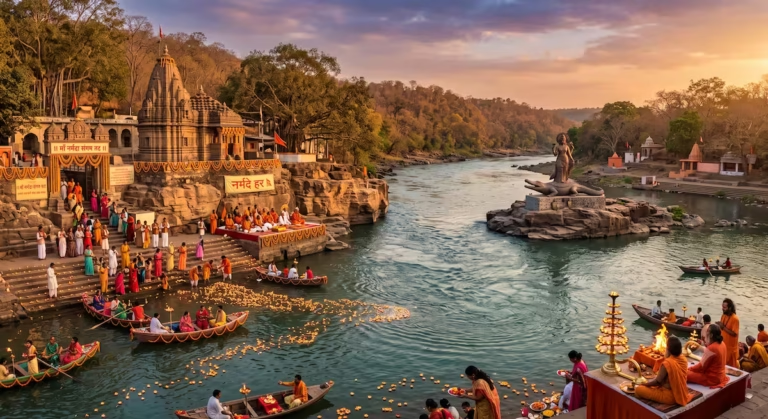
The Narmada River is one of India’s most sacred rivers. Rising at Amarkantak in Madhya Pradesh, it flows westward for about 1,312 kilometres before reaching the Arabian Sea. Along its journey, the Narmada meets numerous rivers, streams and smaller waterways. Many of these meeting points are traditionally regarded as Sangams, or sacred confluences.
A traditional Narmada Sangam list records 100 such confluences. The list includes major rivers such as the Banjar, Shakkar, Tawa and Ganjal, as well as smaller streams and sacred waterways whose historic names are not always easy to match with modern maps.
This distinction is important. The traditional list should not be understood as a list of 100 major tributaries. Some entries represent small streams, seasonal waterways or sacred tirthas associated with the Narmada. Modern river names and locations can also differ from traditional names.
For pilgrims undertaking Narmada Parikrama, these Sangams form part of the sacred landscape of the river. Some are major pilgrimage destinations, while others are remembered mainly through local tradition and historical accounts.
What Is a Narmada Sangam?
The Sanskrit word Sangam means a meeting or confluence. In the context of the Narmada, it generally refers to a place where another river, stream or watercourse meets the Narmada.
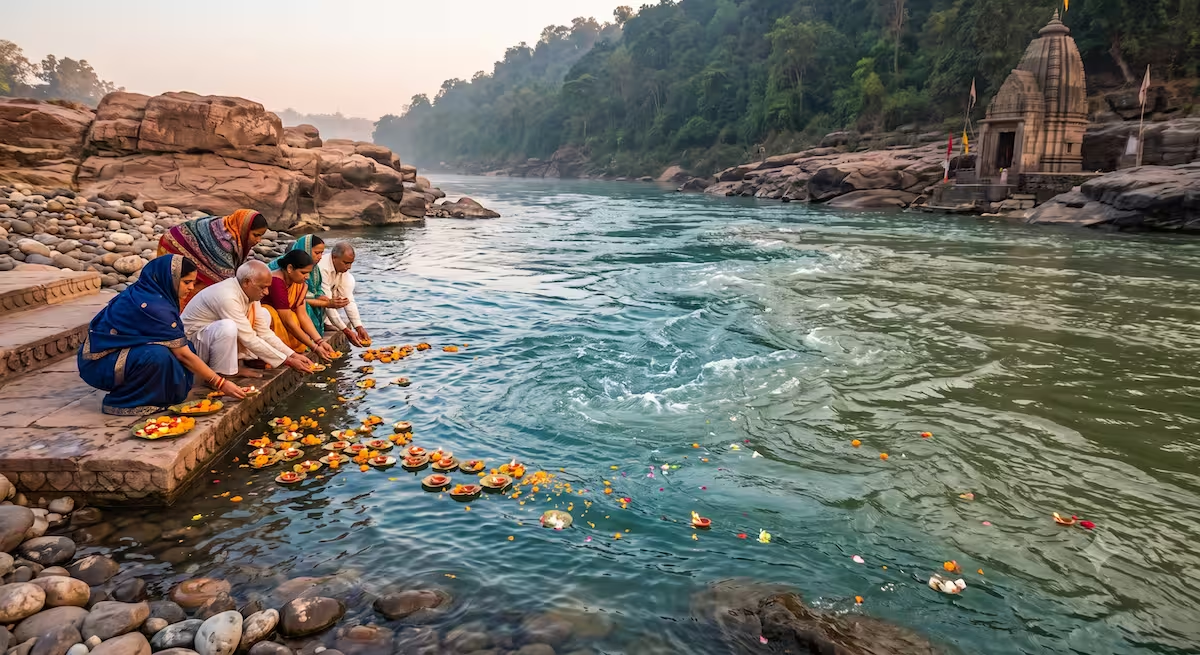
In Hindu pilgrimage traditions, a river confluence is considered spiritually significant because two or more bodies of sacred water meet at one place. Such locations are often associated with bathing, worship, temples, shrines and other religious practices.
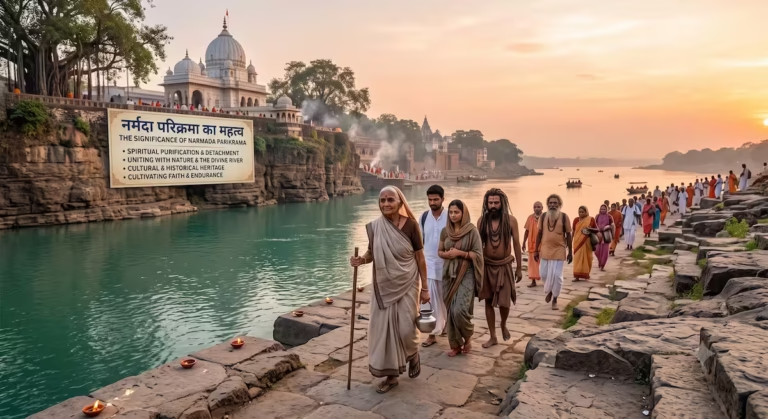
The Narmada tradition gives special importance to these places. During Narmada Parikrama, pilgrims travel along the river and visit numerous sacred sites connected with its banks.
Not every Sangam has the same level of importance. Places such as Omkareshwar, Gangseri and Chandod-Karnali have much stronger modern documentation and pilgrimage infrastructure than many of the smaller Sangams preserved in traditional records.
The Traditional 100 Sangams of the Narmada
The following list follows the traditional 100-Sangam record published by India Water Portal. The original source attributes the research to Dr. Mohini Pravinbhai Joshi of the Sanskrit Department at Gujarat University.
Because several historical river names cannot yet be confidently matched with present-day waterways, the table distinguishes traditional records from modern identifications.
Sangams 1–25
| No. | River / Stream | Traditional Location | Modern Identification |
|---|---|---|---|
| 1 | Kaveri Ganga | Omkareshwar | Narmada–Kaveri Sangam |
| 2 | Khadda | Premgarh | Not confidently identified |
| 3 | Dantoni | Hardaya Kheda | Requires further verification |
| 4 | Bagdi | Near Hardaya Kheda | Not confidently identified |
| 5 | Jambuvati | Near Nemawar | Not confidently identified |
| 6 | Goni | Near Jamner | Not confidently identified |
| 7 | Kakedi | Khedi village | Not confidently identified |
| 8 | Seep | Chhipaner | Requires verification |
| 9 | Kolar / Kosalya | Near Chhipaner | Kolar River candidate |
| 10 | Chatmarni | Near Dimawar | Not confidently identified |
| 11 | Bhaganer | Holipura Ghat | Not confidently identified |
| 12 | Tindari | East of Holipura Ghat | Not confidently identified |
| 13 | Gadariya | East of Budhni Ghat | Not confidently identified |
| 14 | Chandni | Near Vanarbhalu Tirtha | Not confidently identified |
| 15 | Nardi | Bhotalsir | Not confidently identified |
| 16 | Varuna | Bagalwada Ghat | Not confidently identified |
| 17 | Tendoni | Akashdeep | Not confidently identified |
| 18 | Khandad | Ketudhan Ghat | Not confidently identified |
| 19 | Sinori | East of Richhavar Ghat | Not confidently identified |
| 20 | Harni | East of Pithora Ghat | Not confidently identified |
| 21 | Vamanganga | Bhedaghat | Requires modern identification |
| 22 | Saraswati | Lameta Ghat | Historic/local identification |
| 23 | Gaur | Gaur Sangam | Requires verification |
| 24 | Baili | Padmi Ghat | Not confidently identified |
| 25 | Mahodar | Near Padmi Ghat | Not confidently identified |
Sangams 26–50
| No. | River / Stream | Traditional Location | Modern Identification |
| 26 | Dupatta | Near Bilgarh | Not confidently identified |
| 27 | Sangi | Kutarai village | Not confidently identified |
| 28 | Kanhaiya | Near Patpara | Not confidently identified |
| 29 | Katori | Devra village | Not confidently identified |
| 30 | Kulhar | Near Kandakapa | Not confidently identified |
| 31 | Tedhi | Near Kulhar Sangam | Not confidently identified |
| 32 | Dan | Kanchanpur | Not confidently identified |
| 33 | Deori | Near Kanchanpur | Not confidently identified |
| 34 | Varnaganga | Bhimkundi | Not confidently identified |
| 35 | Barati | Damgarh Ghat | Not confidently identified |
| 36 | Neelganga | Kapildhara | Local stream identification required |
| 37 | Gayatri–Savitri | Near Kapildhara | Traditional sacred streams |
| 38 | Karganga | Mandla | Not confidently identified |
| 39 | Kadwa | Near Karanjia | Local tributary candidate |
| 40 | Tudar | Near Karanjia | Not confidently identified |
| 41 | Seoni | Saraswaha | Not confidently identified |
| 42 | Chikrar | Gadasarai | Not confidently identified |
| 43 | Machrar / Gomti | Kukkura Math | Local stream identification required |
| 44 | Kotral | Bichhiya | Not confidently identified |
| 45 | Budner | Devgram | Budner River candidate |
| 46 | Mandakini | Near Ramnagar | Local/historic stream |
| 47 | Kharmer | Near Ramnagar | Kharmer River |
| 48 | Banjar | Mandla | Banjar River |
| 49 | Saraswati | Mandla | Local/historic Saraswati |
| 50 | Banjar / Banja | Maharajpur | Requires mapping |
Sangams 51–75
| No. | River / Stream | Traditional Location | Modern Identification |
| 51 | Senior | Vikrampur | Historic/local stream |
| 52 | Sedh | Sagun Ghat | Not confidently identified |
| 53 | Sukhayen | Chalanga Ghat | Not confidently identified |
| 54 | Lehara | Lehara Sangam | Local stream |
| 55 | Shakkar | Shokhalpur Ghat | Shakkar River |
| 56 | Shera | East of Shokhalpur Ghat | Not confidently identified |
| 57 | Dudhi | Sirsiro Ghat | Dudhi River candidate |
| 58 | Rayan | Near Vankhedi Ghat | Not confidently identified |
| 59 | Tawa | Vanarbhalu Tirtha | Tawa River |
| 60 | Keolari | Randhal Ghat | Not confidently identified |
| 61 | Hathed / Haran | Gomukha Ghat | Requires verification |
| 62 | Eindana | Bhola village | Not confidently identified |
| 63 | Ganjal | Gonda Ghat, Gangseri | Ganjal River |
| 64 | Gomti | Gangseri | Local Gomti |
| 65 | Bakul | Manoharpur | Not confidently identified |
| 66 | Chhota Tawa | Baldi village | Local stream/branch |
| 67 | Kaveri Ganga | Near Satmatra | Traditional local waterway |
| 68 | Varahi Ganga | Between Satmatra and Omkareshwar | Traditional stream |
| 69 | Chandavega | Between Satmatra and Omkareshwar | Not confidently identified |
| 70 | Daraddi | Between Satmatra and Omkareshwar | Not confidently identified |
| 71 | Khadak | Near Raverkhedi | Not confidently identified |
| 72 | Veda | Lepa Ghat / Markandeya Tirtha | Requires verification |
| 73 | Vakhgarh | Near Khalghat | Not confidently identified |
| 74 | Buradh | Brahman village | Not confidently identified |
| 75 | Dev | Maruki Chichli | Not confidently identified |
Sangams 76–100
| No. | River / Stream | Traditional Location | Modern Identification |
| 76 | Nahili | Kesarpura | Not confidently identified |
| 77 | Goi | Bhoti Ghat | Not confidently identified |
| 78 | Bahadal | Bahadal village | Not confidently identified |
| 79 | Udi | Nakta Ki Chowki | Not confidently identified |
| 80 | Khada | Damkheda | Not confidently identified |
| 81 | Dehri | Near Pendra | Not confidently identified |
| 82 | Chasanduri | East of Dehri Sangam | Not confidently identified |
| 83 | Mokshaganga | Mokhdi village | Traditional sacred stream |
| 84 | Andwahi | Rampura village | Not confidently identified |
| 85 | Kariya / Nagwa | Sandgam | Not confidently identified |
| 86 | Daraddi | Near Kolyad | Not confidently identified |
| 87 | Or | Karnali Triveni Sangam | Orsang / Or |
| 88 | Ashwapani | Chudeshwar village | Not confidently identified |
| 89 | Sindoor | Makarkheda | Not confidently identified |
| 90 | Banganga | Devdi village | Banganga candidate |
| 91 | Hatni | Shoolpaneshwar forest | Hatni River |
| 92 | Batrad / Vagadh | Near Devmay Chalang Tirtha | Not confidently identified |
| 93 | Bagu | Bagishwar Tirtha | Not confidently identified |
| 94 | Man | Near Riddheshwar Tirtha | Man River candidate |
| 95 | Karam | Khalghat Triveni Sangam | Local stream |
| 96 | Buti | Khalghat Triveni Sangam | Local stream |
| 97 | Gadi | Near Maheshwar | Requires mapping |
| 98 | Nan | Nan Sangam | Not confidently identified |
| 99 | Malan | Pathral village | Not confidently identified |
| 100 | Ganga Charu | Near Sangameshwar Tirtha | Traditional stream |
The complete traditional list is based on Dr. Mohini Pravinbhai Joshi’s research paper.
Major Narmada Sangams
While the traditional list contains 100 Sangams, several confluences stand out because they have stronger modern documentation and continuing pilgrimage importance.
Narmada–Kaveri Sangam at Omkareshwar
Omkareshwar is one of the most important pilgrimage centres on the Narmada. The Narmada and the local Kaveri meet in the sacred landscape surrounding Omkareshwar.
The Kaveri here should not be confused with the major Kaveri River of southern India. It is a local river associated with the Omkareshwar region.
The Sangam forms part of the broader Omkareshwar pilgrimage circuit, which also includes Jyotirlinga worship and numerous temples along the Narmada.
Narmada–Ganjal–Gomti Sangam at Gangseri
Gangseri is particularly important because the traditional list identifies both the Ganjal and Gomti with this area.
Madhya Pradesh Tourism identifies the area around Gangesari Math as a confluence of the Narmada, Ganjal and local Gomti rivers.
This makes it an important example of a traditional Sangam that can be connected with a modern, documented Triveni location.
Narmada–Orsang–Gupt Saraswati Sangam at Chandod-Karnali
The Chandod-Karnali area in Gujarat is one of the most important Sangam landscapes of the lower Narmada.
Here, the Narmada is traditionally associated with the meeting of the Orsang and Gupt Saraswati. The location is particularly significant for Hindu pilgrimage and ancestral rituals.
The traditional 100-Sangam list records the river as “Or” at Karnali Triveni Sangam. Modern sources generally identify this river as the Orsang.
This is an excellent example of why historical and modern river names should be shown side by side.
Major Narmada Tributaries Among the 100 Sangams
Not all 100 entries are major rivers. However, several significant modern tributaries appear in the traditional list.
Banjar River
The Banjar is one of the important tributaries of the Narmada in eastern Madhya Pradesh. The traditional list records Banjar at Mandla and again records a Banjar/Banja Sangam near Maharajpur.
Shakkar River
The Shakkar is a significant tributary of the Narmada in the central Narmada basin. The traditional list associates its Sangam with Shokhalpur Ghat.
Tawa River
The Tawa is among the best-known tributaries of the Narmada. It joins the Narmada in the Narmadapuram region and plays an important role in the river’s hydrology.
The traditional Sangam list associates Tawa with Vanarbhalu Tirtha.
Ganjal River
The Ganjal is an important tributary in the Narmada basin. Its association with Gangseri is particularly significant because the location is described as part of a three-river confluence.
Orsang River
The Orsang is one of the major rivers of eastern Gujarat. Its meeting with the Narmada near Chandod-Karnali forms one of the most important Sangam sites in the lower Narmada region.
Religious Significance of Narmada Sangams
Sangams have a special place in Hindu sacred geography.
A confluence is traditionally viewed as a meeting point of sacred waters. Pilgrims may visit these places for bathing, prayer, meditation, offerings and temple worship.
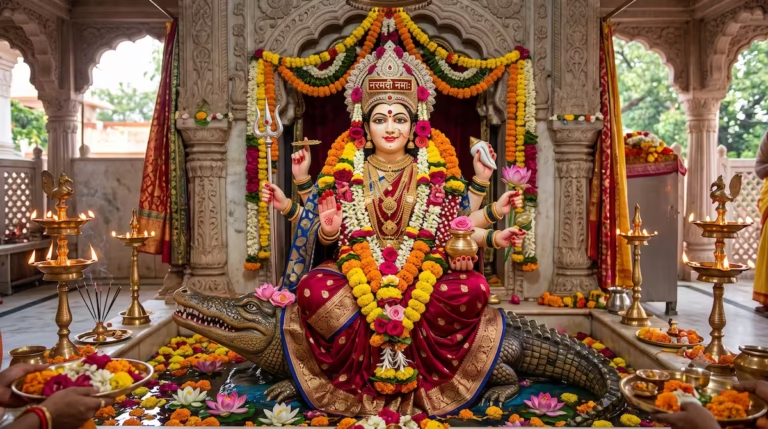
For the Narmada tradition, this significance is closely connected with the river’s status as a sacred mother river.
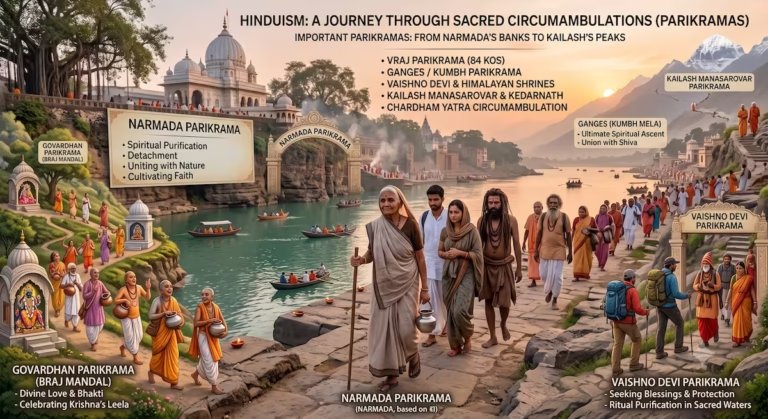
The Narmada is also unusual among India’s major pilgrimage rivers because of the long-standing tradition of Narmada Parikrama, in which pilgrims circumambulate the river rather than simply travelling toward its source or mouth.
The Sangams encountered along this journey become part of the spiritual geography of the Parikrama.
Narmada Sangams and Narmada Parikrama
A Narmada Parikrama traditionally involves travelling along both banks of the Narmada while observing established religious customs.
Pilgrims visit temples, ashrams, ghats, tirthas and Sangams along the route.
However, it would be misleading to suggest that a pilgrim must physically visit all 100 Sangams.
Many entries in the traditional list are small waterways or locations whose modern identity is difficult to establish. Some may also be difficult to reach because of changes in roads, settlements, forests and river channels.
For a practical Narmada Parikrama itinerary, the major documented pilgrimage sites are more relevant than attempting to visit every historical Sangam.
Are There Really 100 Rivers That Meet the Narmada?
No.
The expression “100 Narmada Sangams” should not be interpreted as meaning that exactly 100 major rivers flow into the Narmada.
The traditional list contains different types of watercourses and sacred places. Some are major tributaries. Others are small streams, seasonal waterways or sacred names preserved in local and religious traditions.
This explains why some names in the list cannot be easily found on modern maps.
It is therefore more accurate to describe these as 100 traditional Sangams associated with the Narmada rather than 100 major tributaries.
Traditional River Names vs Modern Names
River names can change over centuries.
A traditional source may record a river under a Sanskrit name, a local name or an older spelling. Modern maps may use a different name entirely.
For example, the traditional list records “Or” at the Karnali Triveni Sangam, while modern sources identify the river as the Orsang.
Similarly, names such as Saraswati, Gayatri, Savitri and Mokshaganga may have religious or traditional meanings that do not correspond directly to large modern rivers.
This is why historical Sangam research needs to compare:
- traditional texts
- local traditions
- modern topographic maps
- government geographical records
- satellite imagery
- historical maps
- pilgrimage literature
A modern identification should only be made when there is sufficient evidence.
Can You Visit All 100 Narmada Sangams?
Probably not as a practical pilgrimage.
Some Sangams are clearly identifiable and accessible. Others are located in areas where the traditional name does not have a clear modern equivalent.
Some waterways may also be seasonal, while others may have changed course or been affected by development.
A better approach is to identify the major accessible Sangams and then research the smaller traditional Sangams separately.
For serious researchers and Narmada Parikrama pilgrims, the traditional list remains valuable because it preserves names and locations that may otherwise disappear from local memory.
Frequently Asked Questions About Narmada Sangams
How many Sangams are there on the Narmada River?
A traditional record identifies 100 Sangams associated with the Narmada River. These include major tributaries, smaller streams, local waterways and sacred confluences. They should not be interpreted as 100 major rivers.
What are the 100 Sangams of Narmada?
The 100 Sangams are a traditional list of places where rivers, streams or sacred waterways are associated with the Narmada. The list includes names such as Kaveri Ganga, Banjar, Shakkar, Tawa, Ganjal, Gomti, Or and Hatni.
Which is the most famous Narmada Sangam?
There is no single officially designated “most famous” Sangam. The Narmada–Kaveri Sangam at Omkareshwar and the Triveni Sangams at Gangseri and Chandod-Karnali are among the more significant and better documented pilgrimage confluences.
Where is Narmada Triveni Sangam?
There are several traditional Triveni Sangam locations associated with the Narmada. Important examples include Gangseri, where the Narmada, Ganjal and local Gomti are associated with the confluence, and Chandod-Karnali, where the Narmada, Orsang and Gupt Saraswati are traditionally associated.
Which rivers meet the Narmada River?
Major rivers and tributaries associated with the Narmada include the Tawa, Banjar, Shakkar, Ganjal, Orsang, Kolar and Hatni, among others. The traditional 100-Sangam list also includes many smaller waterways.
What is the religious significance of Narmada Sangam?
Sangams are traditionally considered sacred meeting places of rivers. Pilgrims may visit them for bathing, prayer, worship and other religious practices. Their importance is especially connected with the sacred geography of Narmada Parikrama.
Can all 100 Narmada Sangams be visited?
Not necessarily. Several Sangams in the traditional list cannot currently be confidently matched with modern waterways. Some may also be difficult to access. Major documented Sangams are more practical pilgrimage destinations.
What is the difference between Sangam and Triveni Sangam?
A Sangam is a confluence where two waterways meet. Triveni Sangam traditionally refers to a meeting of three rivers or sacred watercourses. In Narmada traditions, some Triveni locations include rivers that are described as hidden or “Gupt” waterways.
Is the Kaveri at Omkareshwar the same as the Kaveri of South India?
No. The Kaveri associated with Omkareshwar is a local watercourse in the Narmada region. It should not be confused with the major Kaveri River that flows through Karnataka and Tamil Nadu.
Why do some Narmada Sangams have different names on modern maps?
River names can change over time. Traditional sources may preserve older names, local names or religious names. Modern maps may use different names, and some smaller streams may no longer be clearly identifiable.
Final Thoughts
The 100 Sangams of the Narmada are best understood as a record of the river’s sacred landscape rather than a simple list of tributaries.
Some Sangams are major geographical confluences that remain easily identifiable today. Others survive mainly through traditional names, local memory and pilgrimage literature.
For anyone studying Narmada Parikrama, this distinction is important. The river is not only a geographical feature. Its banks contain an interconnected network of temples, tirthas, ghats, forests, villages and sacred confluences.
The traditional list of 100 Sangams preserves part of that cultural geography. Modern mapping can help identify some of these places, while others require further historical and field research.
Together, these records offer a deeper way to understand the Narmada: not simply as a river flowing from Amarkantak to the Arabian Sea, but as a sacred landscape shaped by thousands of years of pilgrimage and tradition.
Sources and Research Note
The traditional 100-Sangam list is based on the published India Water Portal compilation attributed to research by Dr. Mohini Pravinbhai Joshi of Gujarat University’s Sanskrit Department.
Modern identification should be treated separately from the traditional record. Where a present-day river or confluence cannot be independently verified, this article deliberately retains the traditional name rather than assigning an uncertain modern identity.